The dispute between BYD and one of the most prominent bloggers specializing in Chinese electric vehicles has intensified following tests conducted by the blogger on the Blade Battery 2.0, after he revealed that the company had, according to him, filed a police report against him over the test results he published online.
These developments come months after controversy surrounding battery temperatures during fast charging, including field tests, a complete teardown of the battery pack, and retesting inside an accredited laboratory, alongside regulatory measures affecting the blogger’s accounts on social media platforms.

الدليل
Police report.. without official confirmation
In a post on Weibo dated July 30, 2026, the blogger known as Cai Shen Dao said that BYD had filed a report against him with the Songjiang police station in Shanghai, adding that he had handed investigators hundreds of pages of test records and supporting documents.
So far, neither BYD nor the Shanghai police has officially confirmed that the report was filed, accepted, or that an official investigation into the case had been opened.
Restrictions on the blogger’s accounts
This development was preceded by administrative measures taken by the Cyberspace Administration in the city of Shenzhen against the blogger’s account during July, as part of China’s “Qinglang” campaign. State media indicated that the measures were taken because information and test results had been published that regulators deemed “misleading” and harmful to the reputation of a company.
The penalties included restrictions on posting, commenting, and generating revenue from the account, according to Chinese media reports.
The dispute begins: A fast-charging test
The case began in May 2026, when the blogger livestreamed a test of a Fangchengbao Tai 3 equipped with a Blade Battery 2.0.
During the test, the battery was charged from 8% to 97%, while five temperature probes mounted on the battery’s outer surface recorded a maximum temperature of 76.42 degrees Celsius. Meanwhile, the vehicle’s battery management system (BMS) displayed a reading of approximately 71 degrees Celsius, a difference of up to about 6.5 degrees depending on the location of the probes.
The published data confirmed that the measurements concerned the outer surface temperature of the battery cells, rather than the internal temperatures used by the battery management system.
The tests also showed no signs of battery failure or thermal runaway.
Complete battery teardown
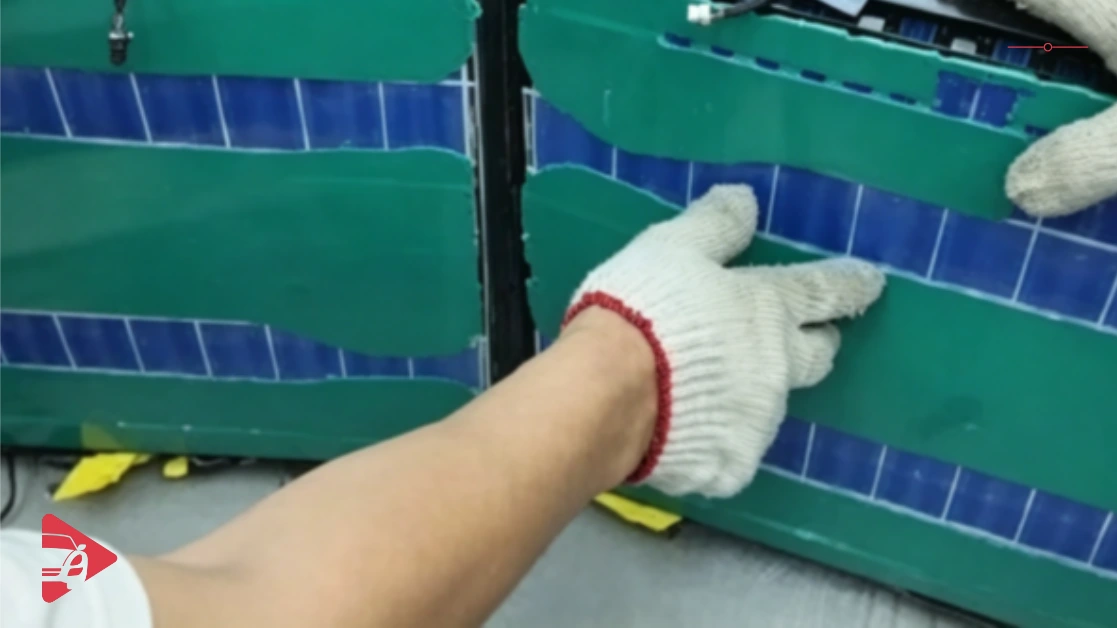
Later in May, the blogger’s team carried out a complete disassembly of the battery pack after freezing it for approximately 40 hours.
The disassembly process took about eight hours using cutting and grinding tools. According to the team, it showed that the battery contains 170 cells connected in series and uses a lattice-reinforced structure with a direct cooling system. It weighs approximately 572 kilograms, with a pack integration efficiency estimated at around 73.6%.
The team noted that the disassembly damaged the adhesives, thermal insulation, and cooling systems. Therefore, the disassembled battery no longer represented its original factory operating condition.
Retesting inside an accredited laboratory
After his accounts were restricted on social media, the blogger commissioned the China National Energy Battery Innovation Center (Guolian Research Institute) to retest the battery inside an accredited laboratory.
The laboratory conducted the test on a Fangchengbao Tai 3 AWD equipped with an LFP battery with a capacity of 78.72 kilowatt-hours.
During charging from 7% to 97%, which took 8 minutes and 32 seconds, the laboratory recorded a charging current of approximately 1,200 amperes.
The results showed that the outer surface temperature of the cells reached 78.5 degrees Celsius, while the battery management system recorded approximately 70.5 degrees Celsius, a difference of nearly 8 degrees Celsius between the two measurements.
The report confirmed that the probes were attached to exposed cells after the battery structure had been modified. Therefore, the results reflect localized surface temperatures under test conditions different from those of the original battery sealed at the factory, and cannot be considered representative of actual operating conditions.
Documents he claims prove communication with BYD
On July 31, the blogger published images that he said documented correspondence with an entity he claimed represented BYD. He explained that it had contacted him on May 5, one day before the battery test was livestreamed, to discuss the possibility of commercial cooperation.
However, the authenticity of the correspondence, the identity of the sender, and its official relationship with BYD have not been independently verified, and the company has issued no official comment بشأنها.
In the same statement, the blogger accused BYD of using regulatory and legal channels to counter the tests he conducted, citing a Chinese draft law concerning the fight against cyberviolence. However, no official body has confirmed that this legislation applies to the current case.
The case remains open
As of the time this report was prepared, no court rulings or official investigation results had been issued, and neither the Chinese authorities nor BYD had confirmed that an official investigation had been opened into the report mentioned by the blogger.
The case remains one of the most prominent examples highlighting the growing controversy surrounding independent testing of electric vehicle batteries and the limits of comparing external measurements with battery management system data amid intensifying competition in China’s electric vehicle market.